Reading the IoT Components article first can help you understand IoT levels more clearly. Each level represents a different way to distribute devices, services, storage, analysis, and applications.
Level 1
A Level 1 IoT system contains one device or node that performs sensing or actuation, stores data, and performs analysis locally.
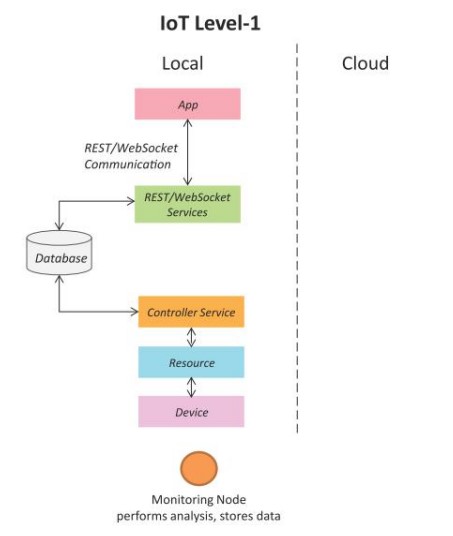
Level 1 is suitable for simple prototypes and low-cost solutions where the amount of data is small and local analysis is enough.
Level 2
A Level 2 IoT system contains one node that performs sensing or actuation and local analysis, while data is stored in the cloud.
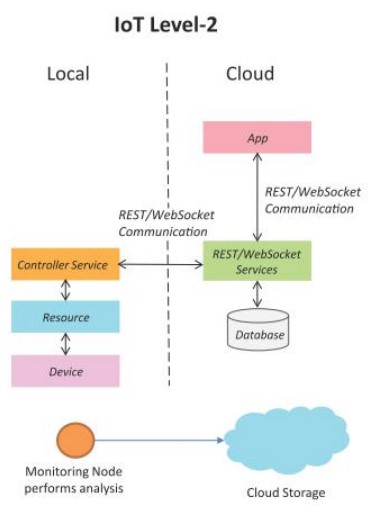
Level 2 is useful when the data is larger than a simple local-only system, but the analysis requirements are still not very complex.
Level 3
A Level 3 IoT system contains one node, while data storage and analysis are performed in the cloud. The application is also usually cloud-based.
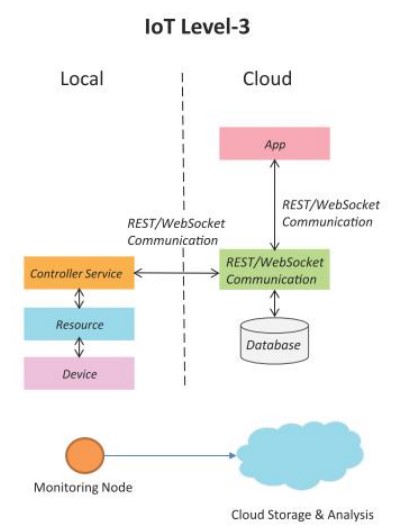
Level 3 is suitable for solutions that require relatively large data storage and stronger cloud-based analysis.
Level 4
A Level 4 IoT system contains multiple nodes that perform local analysis, while data storage and the application are based in the cloud.
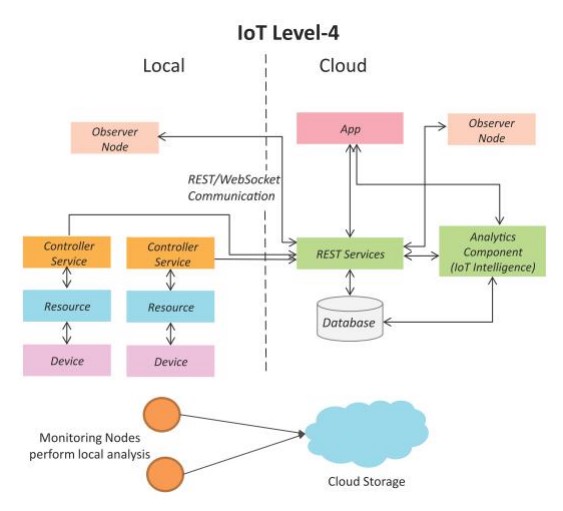
Level 4 is suitable for systems with multiple nodes, large amounts of data, and more intensive analysis needs.
Level 5
A Level 5 IoT system contains multiple end nodes and one coordinator node. The end nodes perform sensing or actuation, while the coordinator collects data and sends it to the cloud.
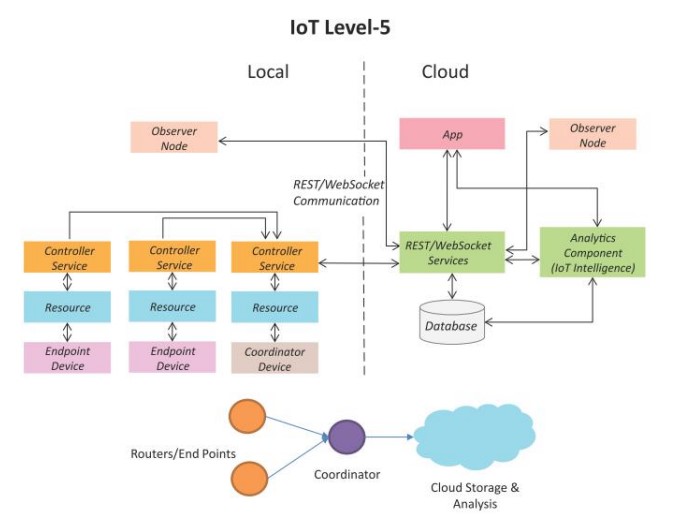
Level 5 is suitable for wireless sensor systems where data volume and analysis requirements are higher.
Level 6
A Level 6 IoT system contains multiple independent nodes that sense or actuate and send data to the cloud. Data, application logic, and analysis are handled through cloud services.
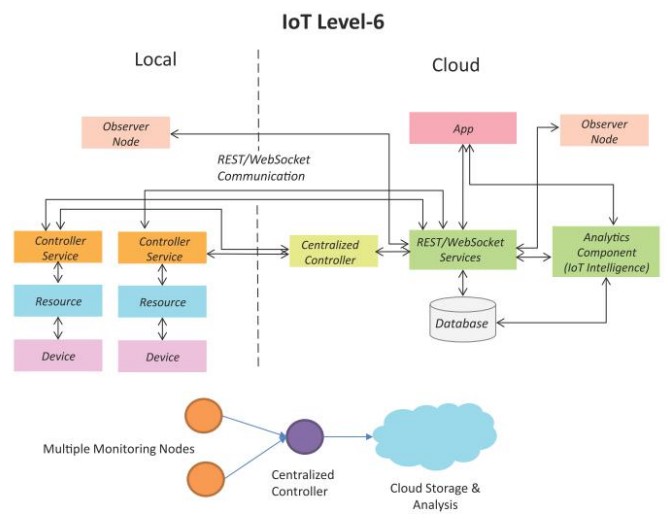
Understanding the Level 6 Diagram
Local Side
Device: Devices exist in the local environment, such as sensors or actuators. They collect data or perform specific actions.
Resource: Resources represent the local functions connected to devices. They allow the system to access device data or control device behavior.
Controller Service: This service communicates with resources and manages connected devices.
Centralized Controller: The centralized controller collects data from multiple controller services and coordinates communication with the cloud.
Observer Node: An observer node monitors the system and provides reports or status updates.
Cloud Side
REST/WebSocket Services: These services transfer data between the local side and the cloud.
Database: The database stores data received from local systems for long-term access.
Analytics Component: The analytics component processes data and produces insights or predictions.
Application: The application allows users to view results, reports, and control options.
Summary
IoT levels help explain how systems scale based on the number of devices, data volume, location of analysis, and storage requirements. Higher levels usually involve more nodes, more cloud services, and more advanced coordination.