This article introduces sensors used in Internet of Things systems and explains how they convert physical changes into data that can be read and processed by a device.
The article covers:
- Basics of sensors in IoT.
- Characteristics of sensors.
- Sensor classifications.
- Common sensor types.
Basics of Sensors
A sensor can detect physical changes in the environment such as temperature, pressure, air quality, smoke, metal detection, or the distance from an object.
Sensors can also detect acceleration, direction, vibration, smell, gases, humidity, and movement depending on their type and design.
In general, a sensor converts physical energy such as heat, sound, pressure, stress, vibration, or motion into an electrical signal that can be processed by an embedded system.
Characteristics of Sensors
Accuracy
Accuracy describes how close a sensor reading is to the true value. A smaller difference between the measured value and the true value means better accuracy.
- Absolute Error = Measured Value - True Value
- Relative Error = Absolute Error / True Value
Range
Range is the minimum and maximum value a sensor can measure correctly. Outside this range, the sensor may produce inaccurate readings.
Resolution
Resolution is the smallest change in input that a sensor can detect. Higher resolution allows the sensor to detect smaller changes.
Precision
Precision means that the sensor gives similar readings when measuring the same value under the same conditions multiple times.
Classifications of Sensors
- Passive and active sensors.
- Analog and digital sensors.
- Scalar and vector sensors.
Passive Sensor
A passive sensor cannot detect input independently and depends on an external physical effect or energy source. Examples include temperature, humidity, acceleration, and water level sensors.
Active Sensor
An active sensor can detect input by generating a signal and measuring the response. Examples include radar sensors and laser distance sensors.
Analog Sensor
An analog sensor produces a continuous output signal that changes according to the input. Examples include temperature, pressure, and light intensity sensors.
Digital Sensor
A digital sensor produces a digital or binary output. It is often easier to process and can reduce issues caused by noise in analog signals.
Scalar Sensor
A scalar sensor measures only the magnitude of the input. Examples include temperature, gas, color, and smoke sensors.
Vector Sensor
A vector sensor depends on both magnitude and direction. Examples include accelerometers, gyroscopes, magnetic field sensors, and motion detectors.
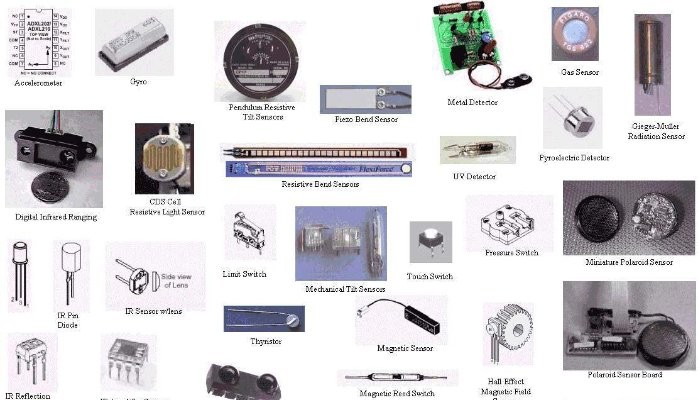
Types of Sensors
- Electrical Sensor
- Light Sensor
- Touch Sensor
- Range Sensor
- Mechanical Sensor
- Optical Sensor
- Speed Sensor
- Ultrasonic Sensor
Summary
Sensors are the starting point for many IoT systems because they collect data from the environment and convert it into signals that can be processed. Understanding sensor basics, characteristics, and classifications helps in selecting the right sensor for each application.